Pages


Tuesday, May 7, 2013

WSRM---LEDlights rebate!


HERE IS LIGHT!HERE IS LIFE!

www.whitesunredmoon.com


WSRM---LEDlights rebate!
onsidering switching your commercial lighting to LEDs this year? Learn how to get the most out of lighting rebates and incentives. 
Have you gone shopping for new light bulbs or fixtures lately? If the answer is yes, you’re probably aware that LED lighting options have saturated the market as energy efficient alternatives to incandescent, halogen, and fluorescent lights.
But, what you might not know is that there are tons of rebates and incentives out there for buying LEDs that can help you save money when making the switch.
Since January 2012 the number of rebate programs for LEDs has increased by 54%.
Here’s an overview of the kind of rebates your company can expect in 2013:
Rebate Snapshot LED 1 13 LED Rebates For 2013
If you’re already familiar with rebates from electric utilities and government organizations in your area, you may notice that the dollar amounts for most rebates have decreased over the past year. The average rebate for an LED replacement lamp has gone down by 7% since last January. Rebates amounts also decreased for LED fixtures: recessed down lights decreased by 66%, accent lighting by 12%, and high bay fixtures by 8%.
You needn’t be alarmed by these numbers, though. They’ve only been adjusted to match the lower prices of LEDs in 2013. Less money is necessary to make purchasing an LED financially attractive. Also, since there are over twice the programs this year, money is even more accessible.
If you’re still pondering a switch to LEDs, or have never considered utilizing LED rebates before, starting to look for them is easier than ever. Currently, you can find rebates and incentives for energy efficient commercial lighting in 71% of the U.S. As the year progresses, we should see that number go up.
WE HAVE A DREAM:BRING OUR LEDlights TO THE WORLDWIDE!

www.whitesunredmoon.com


Monday, May 6, 2013

WSRM---LEDlights advantages and one shortage!


WSRM---LEDlights advantages and one shortage!

LED lights have many advantages over other kinds of lighting, including compact fluorescent lights, or CFLs, an unsafe lighting technology. Here are eight reasons to love LEDs, or light-emitting diodes.

1. LEDs Have Been Around for Decades

LED lighting is a proven technology that's been in widespread use since the 1960s. Traffic lights, electronic instruments and other devices have relied on LED lighting -- and if you're old enough to remember the first geeky calculator you bought in the 1970s, there's a chance it may have been lit with LED light

.

2. LEDs Can Create a Warm, Soft Glow

Some users associate LEDs with a harsh, cold, glaring light, but newer LEDs are capable of producing a warm, soft -- dare I say romantic? -- glow, just like the inefficient incandescent lights that are still widely used.

3. LEDs Are Ridiculously Energy-Efficient

LED lights use 75 to 80 percent less energy than older incandescent lights. And because lighting consumes a significant amount of household energy, the savings can add up fast.

4. LED Lights Will Save You Money

If you're more motivated by cash than by environmental concerns, here's your catnip: LEDs will save you money over both CFLs and regular incandescent lights. One study found that over the lifetime of an LED light (estimated at 50,000 hours), LEDs cost just $95 to operate -- CFLs, by comparison, cost $159 over the same period, and incandescents cost a whopping $652. These figures don't even include the hassles of buying and replacing lights. LEDs cost more up front, true -- you can expect to be at least $10 per bulb, depending on the type and the manufacturer -- but like most new technologies, that cost is dropping every year.

5. LEDs Might Outlast You

If you hate changing burned-out light bulbs, raise your hand -- or, on second thought, don't. LEDs are generally estimated to last at least 25,000 hours, and often up to 50,000 hours. Incandescents only last 1,200 hours, so you'd have to replace an incandescent light 42 times to get the light of a single, solid-state LED. CFLs, by comparison, usually last 10,000 hours, so you'd only have to change them 5 times to match one LED light. And speaking of changing light bulbs...

6. LEDs Contain No Toxic Mercury

I would be a big fan of CFLs if they didn't contain mercury, a toxin associated with birth defects, brain damage and other disorders. That's why CFLs can't be thrown in the trash -- and it's very tricky to clean up a broken CFL. LEDs' biggest advantage over CFLs is that they contain no mercury or other hazardous materials. None. Zip. Nada.

7. LED Lights Are Cool - Literally

Ever try to unscrew a hot light bulb? (Not twice, I'll bet.) Incandescent and halogen lights can be very hot, which leads to a number of safety issues. LEDs, on the other hand, are totally cool even after several hours of use -- they're even cooler than CFLs.

8. LEDs Can Be Dimmed

LED lights can be dimmed, which is not always the case with CFLs. Additionally, LEDs come on instantly (again, better than CFLs) and don't flicker (ditto). Finally, their light output is constant over the lifetime of the lamp, fading only when the lamps are at the end of their very, very long life

.

9. BUT - Not All LEDs Are Created Equal

Unfortunately, the Department of Energy and others have noted that there are some poor-quality LED manufacturers out there selling inferior products that grow dim, shift in color or begin to flicker after just 1,000 hours or so. (Note the two photos at below, after 100 hours and after 1,000 hours.) To protect yourself from these problems, look for WSRM-LEDlights made in good quality.

Sunday, May 5, 2013

WSRM---How to make better your home office lighting!


HERE IS LIGHT!HERE IS LIFE!

www.whitesunredmoon.com


WSRM---How to make better your home office lighting!

Whether you work in a home office or a cubicle farm, the character and quality of lighting in your workspace can go a long way toward making you productive. Poor lighting can dampen morale, produce eyestrain and headaches, and ultimately impair your ability to work effectively. In short, it always pays to pay close attention to workspace illumination. Here are five things to consider when making lighting decisions about your home office.

1. Keep it Indirect

Avoid working under the direct glare of overhead lights. Instead, look for ways to diffuse the ambient light that will illuminate your office space. Lamp shades soften and scatter otherwise harsh light, while an upward-shining floor lamp bounces the light off of walls and ceilings. The goal is to illuminate the entire space without creating undue glare and contrast, while also avoiding casting shadows.

2. Taken to Task

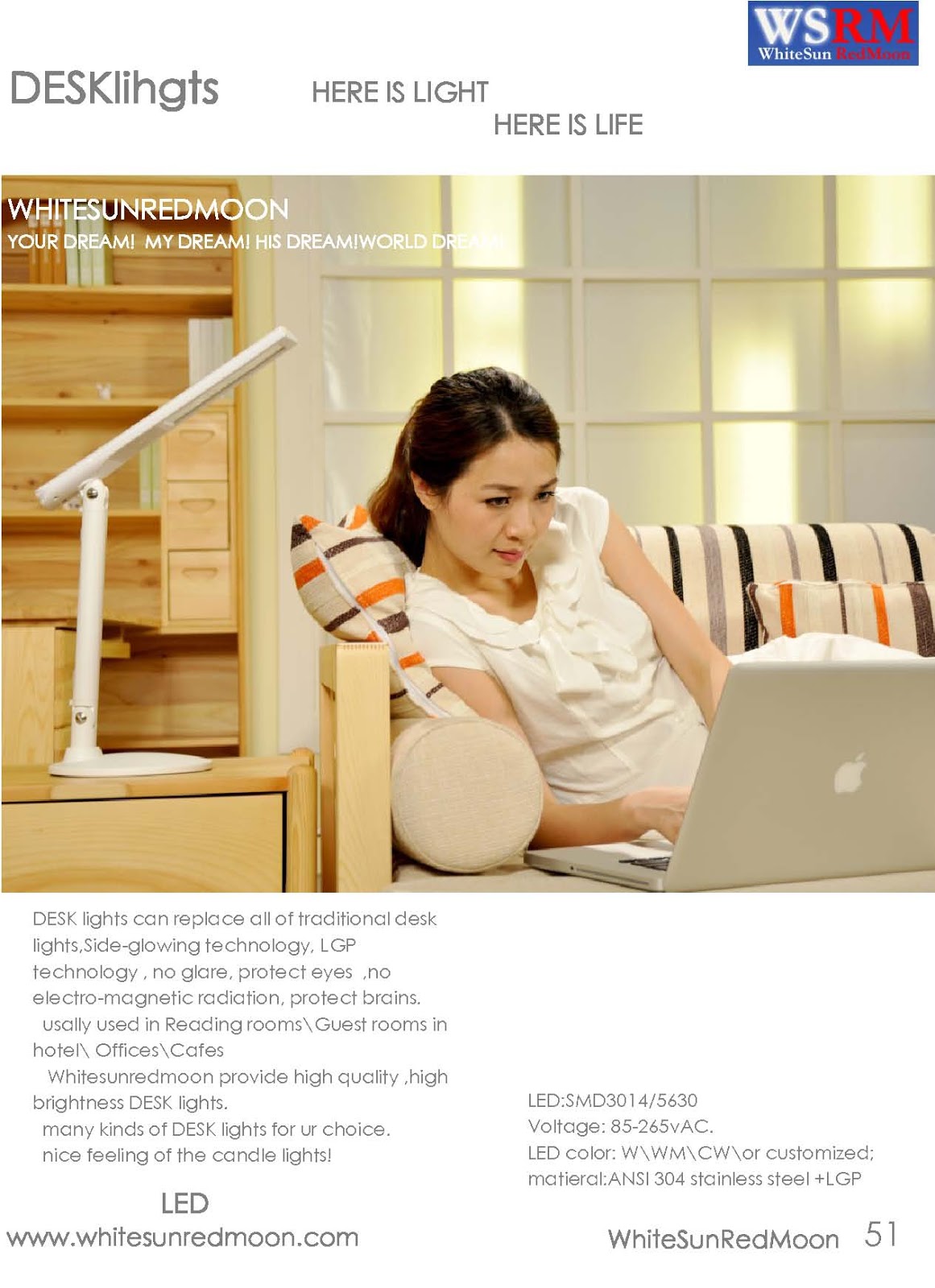
For computer work, filing and other focus-intensive tasks, you’ll want a well-defined light source dedicated to what you are doing. An adjustable or articulated desk lamp can put light exactly where you need it and support a variety of tasks. If your home office has multiple work stations – say a desk for computer and phone work, a filing area, and a table for reviewing photos and layouts – you’ll want dedicated task lighting for each station.

3. Location, Location, Location

Always consider where your light is coming from. A light source set behind you as you work at your computer will almost certainly create annoying glare on your monitor. Likewise, look out for unintended shadows cast by lamps set up for task lighting. For instance, if you write with your right hand, your hand and arm may cast shadows if the task light is also set off on the right. Also, be sure to consider the location of windows when setting up your work spaces.

4. Natural Light

Don’t overlook the unique benefit of natural light coming from a window, skylight or other portal. Sunlight can produce warm lighting that really improves the work environment. On the other hand, you may need to account for direct sunlight that creates overwhelming glare during certain times of day. A simple blind or even a standing screen will do a nice job of diffusing sunlight shining into a window.

5. Accent and Decorative Lighting

As discussed above, most home offices will feature ambient lighting that is diffused throughout the space and task lighting that is focused on specific work stations. Beyond these two functional lighting types, you may want to add decorative and accent lighting to help improve the visual character of your home office. Accent lighting like mantel or picture lights draw attention to objects or other elements in the room, while decorative lights—such as wall sconces—provide direct visual appeal.

I HAVE A DREAM:BRING MY LEDlights TO THE WORLDWIDE!

www.whitesunredmoon.com


WSRM---LEDlights Durability's Difference Between LEDs and CFLs!


WSRM---LEDlights Durability's Difference Between LEDs and CFLs!


We won’t rest until we’ve explored every way LEDs and CFLs differ! This post is part of a series doing just that. So far we’ve covered everything from the basics, like rated-life and energy-efficiency to ore complex topics, like how each source performs in cold temperatures.you will read the series intrmoduction in the next period of time.

Do you know what makes an LEDs durability's different from a CFL? In this blog ,we’re explaining just that!
We all know incandescent light bulbs are delicate. You break that filament, and it’s lights out (literally). It’s easy to understand why our basic incandescent lights are so fragile – we can see and understand the simple internal structure at a glance. But, when it comes to understanding the capabilities of LEDs and CFLs, the answers aren’t as straightforward. Both light sources use more complex systems to generate light, but does this make them any less breakable?
It’s time to dive a little deeper.
LEDs:
Since LEDs don’t use a filament, they can easily withstand almost any kind of jarring vibration. When you’re rough on LEDs, transporting them from place to place while in use, or keeping them in jolt-prone spots (like in and around elevators), you don’t have to worry about easily breaking or damaging them.

CFLs:
While CFLs don’t use the standard incandescent filament to produce light either, they are much more delicate than LEDs. Strong vibrations can quickly degrade the electrodes CFLs use to create light. CFLs are especially prone to damage after the electrodes have been weakened from a few thousand hours of use. If you have CFLs, keep them out of the way so you don’t risk any damage.

www.whitesunredmoon.com


Saturday, May 4, 2013

WSRM---LEDlights glass envelope is different with CFLs!


HERE IS LIGHT!HERE IS LIFE!

www.whitesunredmoon.com


WSRM---LEDlights glass envelope is different with CFLs!

We won’t rest until we’ve explored every way LEDs and CFLs differ! This post is part of a series doing just that. So far we’ve covered everything from the basics, like rated-life and energy-efficiency to ore complex topics, like how each source performs in cold temperatures.you will read the series intrmoduction in the next period of time.

If you’re deciding which light source to use for your next project, look no further! In our blog series, we’re going in-depth to explore the differences between LEDs and CFLs, so you can make the best decision. In this post, we’re talking about structure…
LEDs and CFLs are built very differently.
LED light bulbs use glass or plastic envelopes of almost any thickness. They’re built to last, even in the most demanding circumstances. CFLs, on the other hand, have a daintier construction. If you drop one, the thinner glass envelope could easily break. This can be a problem, especially because CFLs contain trace amounts of mercury that will be released when the light bulb shatters.
To prevent CFLs from cracking so easily, some manufacturers have begun encasing CFLs in silicone coatings, so even if the glass breaks the shards and mercury will stay within the silicone, not allowed to get into your environment. The CFL’s traditional spiral is covered by a more conventionally shaped envelope like this:

As a general rule, we at WSRM Lighting recommend you use LED light bulbs for rougher applications, when the light bulb faces a lot of wear and tear – think traveling or within portable fixtures. For more static, quiet applications, either light bulb should serve you well.

www.whitesunredmoon.com